
The top dark tourism destinations in the world are places associated with death, disaster and tragedy. Yet they attract millions of tourists each year.
Holidays are usually associated with fun, but many tourists also seek unusual, authentic, cultural and educational experiences. The vast majority of visitors to dark tourism sites are not there for entertainment – instead, they gain an insightful and often moving experience.
So what is dark tourism all about, and what are the top dark tourism destinations? This article explains all.
What is dark tourism?

Dark tourism, also known as black tourism, thanatourism or grief tourism, is tourism that is associated with death or tragedy. It is a type of niche tourism.
The act of dark tourism is somewhat controversial, with some viewing it as an act of respect and others as unethical practice. At the same time, many argue that one of the best ways to understand history is to see where it happened, and dark tourism attractions make this possible.
Dark tourism attractions can be world-famous, such as Auschwitz-Birkenau, Hiroshima and the 9/11 Memorial & Museum in New York. Dark tourism can also occur in places that are less well known, such as small cemeteries, zombie-themed events or historical museums.
Dark tourism attractions allow visitors to immerse themselves emotionally in a place of tragedy. This is an excellent facilitator of educational tourism and cultural tourism. Visiting dark tourism sites gives people time to reflect on history.
Dark tourism takes many different shapes and forms. Some types of dark tourism are extreme and serious (e.g. visiting a concentration camp), whilst others are of a more light-hearted nature (e.g. a zombie-themed running race). The dark tourism spectrum and the different types of dark tourism are explained in more detail in this guide to dark tourism.
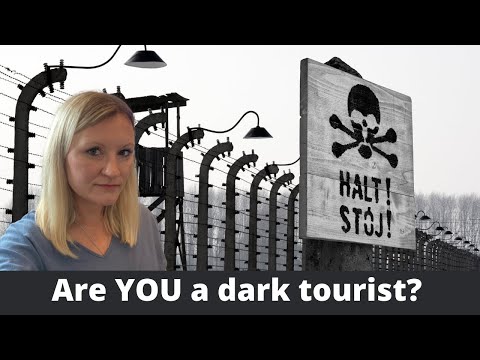
Video: Dark tourism explained
The top 10 dark tourism destinations in the world
Some of the most significant dark tourism destinations in the world are outlined below.
#1 Hiroshima, Japan

Hiroshima is one of the world’s most important dark tourism destinations. On 6 August 1945, the USA dropped an atomic bomb on the city, killing an estimated 140,000 people by the end of that year.
Today, the Hiroshima Peace Memorial Park and Museum tell the story of the bombing and its aftermath, and the ruined Atomic Bomb Dome (Genbaku Dome) is a UNESCO World Heritage Site. The museum receives around two million visitors a year, many of them international tourists and school groups.
A visit to Hiroshima is a deeply moving experience, and the city has positioned itself as a global symbol of peace and a centre for education about the dangers of nuclear weapons. The nearby island of Miyajima means that many visitors combine dark tourism with more traditional sightseeing.
Other cities associated with recent tragedies can also attract dark tourists. After the COVID-19 pandemic, for example, there was some curiosity about visiting Wuhan in China, where the outbreak was first identified, although this has not developed into a significant dark tourism trend.
#2 Chernobyl, Ukraine

The Chernobyl Exclusion Zone became one of the world’s best-known dark tourism destinations, welcoming more than 100,000 visitors a year before the COVID-19 pandemic.
So what happened at Chernobyl?
The Chernobyl disaster of April 1986 was one that rocked the entire world, and still impacts local residents to this day. It is considered the worst nuclear disaster in history.
The Chernobyl Nuclear Power Plant is located near the city of Pripyat in the north of what was then the Ukrainian SSR. Pripyat was evacuated after the disaster and is now a ghost town.
As one of the best-known disasters in history, it has long attracted visitors keen to see where the events unfolded.
However, tourism to Chernobyl has been suspended since Russia’s full-scale invasion of Ukraine in February 2022, when Russian forces occupied the site for several weeks. In February 2025, a drone strike damaged the New Safe Confinement structure that covers the destroyed reactor. Before the war, visitors needed a permit and had to visit with licensed tour operators, passing through checkpoints and radiation monitoring.
When tours were running, guides carried radiation monitoring equipment, and short, guided visits were considered to involve only low radiation exposure.
The abandoned, dystopian landscape was a major draw for many visitors.
Interest in the Chernobyl disaster was boosted by the acclaimed 2019 HBO and Sky drama Chernobyl, which led to a surge in bookings before the pandemic and the war.
#3 Fukushima, Japan

The only other nuclear disaster to be labelled as a level 7 on the International Nuclear Event Scale was the Fukushima Daiichi nuclear disaster.
Similarly to its Ukrainian counterpart, the location of this nuclear accident is one of the world’s leading dark tourism destinations. Caused by the 2011 Tōhoku earthquake and tsunami, the disaster forced more than 150,000 people to evacuate their homes.
Visits to the areas closest to the plant are usually made with specialist tour companies. Real Fukushima offer an unbiased look at the disaster and the recovery efforts. This is thanks to permission from the Fukushima Prefectural Government. Tours show the impact of the disaster and the ongoing recovery, from abandoned buildings to decontamination work. The Great East Japan Earthquake and Nuclear Disaster Memorial Museum, which opened in Futaba in 2020, also tells the story of the disaster.
Visitors can also see parts of the town of Okuma, which once had a population of 11,000 and was evacuated after the disaster. Some areas still lie abandoned, while evacuation orders have been lifted in others. The tour shows visitors how the earthquake and subsequent nuclear disaster affected the area, and how the local people are trying to rebuild their community.
#4 Auschwitz Concentration Camps, Poland

Poland, and Kraków in particular, has become one of Europe’s most popular tourist destinations. And many people visit Krakow because it is a gateway to Auschwitz, the most famous World War II concentration camp – and one of the most visited of the world’s dark tourism destinations. Visiting a concentration camp is an incredibly sombre experience. It is also very educational, and helps visitors understand the sheer scale of the Holocaust. The Auschwitz-Birkenau State Museum received more than 1.8 million visitors in 2024, and in January 2025 marked the 80th anniversary of the camp’s liberation.
Now a museum, Auschwitz can be visited independently or as part of a tour. There is a wealth of information here explaining each part of the camp, and visitors can see many artefacts. There are toys belonging to children who were killed, hair shaved from the victims’ heads, suitcases that were packed when the owners believed they were heading somewhere safe.
World War II is a topic that fascinates many people, and is a topic taught in educational settings too; so visiting former concentration camps is an important experience for many people, including school groups.
#5 Sedlec Ossuary, Czechia

Sedlec Ossuary is one of the lesser-known dark tourism destinations, but it is a fascinating place to visit.
Not far from Prague, Sedlec Ossuary is a church decorated entirely with human bones. It is located in Kutna Hora, which is a short train ride from the Czech capital. The church itself is around 10 minutes from the station on foot, and visitors can buy a combined ticket that grants access to the ossuary itself as well as Saint Barbara’s Cathedral. The money goes towards the upkeep of the churches.
The Sedlec Ossuary is breathtaking – there are bones everywhere. They form chandeliers hanging from the ceiling, and they make words on the walls.
Visitors come face to face with mortality inside this chapel in the heart of Bohemia, which is decorated with the bones of an estimated 40,000 to 70,000 people. It is a popular day trip from Prague and a good example of how death is central to dark tourism.
#6 Oradour-sur-Glane, France

Another disaster site linked to World War II, the village of Oradour-sur-Glane was the scene of a massacre on 10 June 1944, just days after D-Day, when soldiers of the Waffen-SS ‘Das Reich’ division killed almost all of its inhabitants. The reasons for the massacre are still debated, and its impact is still felt today in the ruined streets.
Visitors can enter the church where the women and children were rounded up and killed, and walk the streets where the 643 victims lived.
From rusted bicycles to abandoned sewing machines, evidence of daily life remains here. President Charles de Gaulle ordered that the village remain as a permanent memorial, and there is a museum on site where tourists can learn about this massacre.
It is less well known internationally than some dark tourism sites, but it is one of the most powerful memorials in France.
#7 Aokigahara Forest, Japan

Aokigahara is a dense forest on the north-western flank of Mount Fuji in Japan. It is a beautiful natural area, popular with hikers and visitors to the nearby lava caves, but it has also become sadly associated with suicide, which has led to it being described in the media as the ‘suicide forest’.
The local authorities have placed signs in the forest encouraging people in distress to seek help, and they discourage media coverage that sensationalises the forest’s association with suicide.
This makes Aokigahara a controversial dark tourism destination. Visitors are asked to stay on marked trails and to be respectful, and many people believe that the forest should not be treated as a tourist attraction because of its association with suicide.
The ethical issues were highlighted in 2017, when YouTuber Logan Paul faced worldwide criticism after filming the body of a person who had died in the forest. If you have been affected by the issues raised in this section, support is available – in the UK, Samaritans can be contacted free on 116 123.
#8 Pompeii, Italy

Pompeii is one of the world’s most important archaeological sites, and also one of Europe’s most popular dark tourism destinations, with more than four million visitors in 2024.
The city was frozen in time when Mount Vesuvius erupted in AD 79. Many inhabitants fled, but some were not so lucky. When the city was rediscovered and excavated from the 18th century onwards, archaeologists found voids left in the ash by the bodies of victims, and filled them with plaster to create the famous casts. You can visit the city on tours from Rome and Naples. To manage overcrowding, the site introduced a daily limit of 20,000 visitors and named tickets in 2024.
And you can also visit the volcano itself, Mt. Vesuvius, and see for yourself the impact that nature can have. Visitors can hike close to the crater rim – a reminder that Vesuvius is still an active volcano, with around three million people living in its vicinity.
#9 Killing Fields, Cambodia

The killing fields at Phnom Penh are chilling. They are deeply shocking, but they provide vital education about the genocide that occurred under the Khmer Rouge regime.
Between 1975 and 1979, an estimated 1.5 to 2 million people – around a quarter of Cambodia’s population – died under the Khmer Rouge regime led by Pol Pot. There are actually around 300 killing fields across Cambodia, but the Choeung Ek Killing Fields near Phnom Penh are the best known. In 2025, Choeung Ek, the Tuol Sleng Genocide Museum (the former S-21 prison) and the M-13 prison site were inscribed together on the UNESCO World Heritage List.
On the surface, the fields are beautiful. But any tour guide or historian can explain the horrors that unfolded here. Visitors can see the remnants for themselves: mass graves, holding rooms, trees where soldiers would hang speakers to drown out the cries of those being savagely beaten to death.
There is a pagoda, closed in with glass walls, containing thousands of human skulls. It is a stark reminder of just how many people were killed at this one site alone. It really is a harrowing experience, but again one that does serve to educate visitors.
#10 Robben Island, South Africa
Located just outside Cape Town, Robben Island is a prison island.

This is where Nelson Mandela was imprisoned alongside many others, and subject to some of the harshest conditions. It has been a UNESCO World Heritage Site since 1999, and tourists can visit on tours led by ex-prisoners.
The island was once also a leper colony, and later an asylum. But it was its use as a prison during the Apartheid years that has led to its notoriety.
Robben Island is now a powerful symbol of the struggle against apartheid and of reconciliation, and a tour led by former political prisoners is a uniquely moving experience.
Dark tourism destinations: FAQs
Below are answers to some of the most common questions about dark tourism destinations.
What is dark tourism?
Dark tourism, also known as thanatourism or grief tourism, is travel to places associated with death, tragedy or disaster, such as former battlefields, genocide memorials and disaster sites.
What are the most popular dark tourism destinations?
Some of the most visited dark tourism destinations include Auschwitz-Birkenau in Poland, Hiroshima in Japan, the 9/11 Memorial in New York, Pompeii in Italy, the Killing Fields in Cambodia and Robben Island in South Africa.
Can you still visit Chernobyl?
Tourism to the Chernobyl Exclusion Zone has been suspended since Russia’s full-scale invasion of Ukraine in February 2022.
Is dark tourism ethical?
Dark tourism can be ethical when visitors behave respectfully and sites are managed to educate and commemorate. It becomes unethical when tragedy is sensationalised or exploited for entertainment or profit.
Why do people visit dark tourism sites?
People visit dark tourism sites to learn about history, remember and pay respect to victims, reflect on human behaviour, connect with their heritage or out of curiosity.
Dark tourism destinations: Further reading
Recommended books on this topic:
- Hell Hole, Robben Island: Reminiscences of a Political Prisoner
- The Last Road to Cambodia
- Apocalypse Pompeii
Books and personal accounts can add to an understanding of dark tourism sites. Examples include Hell-Hole, Robben Island: Reminiscences of a Political Prisoner by Indres Naidoo, First They Killed My Father by Loung Ung, and The Twins of Auschwitz by Eva Mozes Kor. If you found this article useful, these articles may also be of interest:
- Dark tourism explained
- Types of tourist attractions
- What is disaster tourism and is it ethical?
- What is ethical tourism?
- What is a human zoo?
