
Cruise tourism is big business! According to Cruise Lines International Association (CLIA), a record 37.2 million people took an ocean cruise in 2025, up 7.5% on 2024, and the industry expects 40 million cruise passengers a year by 2030. In 2024, cruise tourism generated an estimated US$198 billion in global economic impact and supported 1.8 million jobs worldwide.
Cruise tourism is essentially a form of enclave tourism and it encompasses all facets of the tourism industry- accommodation, transportation, hospitality and attractions. Cruising is one of the fastest-growing segments of the travel industry, helped by the wide variety of cruises on offer.
Cruise tourism is hugely popular around the world, but it can also have severe impacts on the natural environment and limited economic benefits for host destinations. This article explains what cruise tourism is, its history, the main types of cruise and destinations, and its advantages and disadvantages.
What is cruise tourism?

Cruise tourism refers to holidays which are entirely or partly based on a cruise ship. It enables tourists to experience a multi-centre holiday, whereby they spend time at various destinations throughout their trip.
Cruise ships vary from small yachts to mega ships and can take place on the ocean, river or fjords. Cruise tourism is popular in the Caribbean, Mediterranean and Arctic amongst other destinations.
In essence, cruise tourism is a form of travel, involving an all-inclusive holiday on a cruise ship of at least 24 hours, with a set and specific itinerary, in which the cruise ship calls at several ports or cities. Cruise tourism is characterised by the concentration of large numbers of people who visit one particular destination at the same time.
For students and teachers of cruise tourism, two useful texts are Cruise Ship Tourism and Cruise Operations Management: Hospitality Perspectives. These texts cover the areas discussed in this article in more detail as well as discussing the impacts of cruise tourism and relevant management perspectives.
Video: How does cruise tourism work?

History of cruise tourism
Cruise tourism has a long history. The Peninsular and Oriental Steam Navigation Company (P&O), whose origins date back to 1822 and 1837, began offering leisure voyages in 1844, and is often credited with the birth of leisure cruising. Although the company started out as a shipping


line, it soon introduced round trips to a range of destinations. Over the next century more and more cruise liners began to emerge around the world and in the late 19th century, Albert Ballin, director of
the Hamburg-America Line, was the first to send his transatlantic ships out on long southern cruises during the worst of the winter season of the North Atlantic.
Fast forward to the 1980s and we started to see the development of cruise ships closer to what we recognise today. The first ‘megaships’ were built and cruise ships gradually became bigger and more luxurious with more onboard facilities than ever before.
Today, the largest cruise ships carry more people than many small towns. Cruise ships have a wide range of onboard features and there are cruise ship itineraries that cater for every corner of the globe.
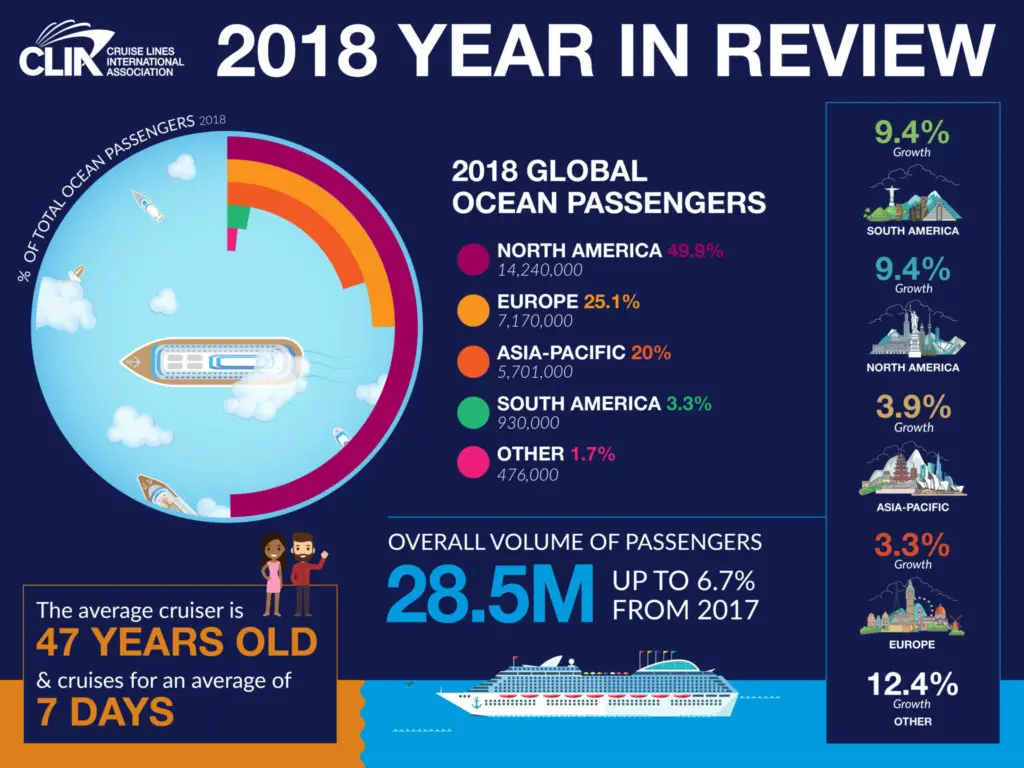
For many, cruising has been perceived as an activity for the older generation. The Cruise Lines International Association reported the following profile of the average cruise passenger in 2008:
- 93% Caucasian.
- Average age of 46-year-old.
- Well-educated (65% graduate, 24% post-graduate)
- 83% married.
- 58% work full-time.
- Average household income of USD$90,000.
Since then, cruise ships have become more diverse in their offered services: Offering a variety of onboard services to appeal to a variety of demographic groups, such as; couples, families, the younger generation, sports enthusiasts and the older generation. According to CLIA, the average age of cruise passengers is now around 46, and younger travellers and multi-generational families make up a growing share of the market.
With the diverse demographic groups motivated by cruise tourism, there comes a variety of cruise types.
Cruise tourism companies
The cruise market is dominated by a small number of large groups- Carnival Corporation (which owns brands including Carnival, Princess, P&O Cruises and Cunard), Royal Caribbean Group, Norwegian Cruise Line Holdings and MSC Cruises. Some of the best-known cruise brands are outlined below.
Cunard
Cunard has been operating for more than 185 years and specialises in traditional luxury cruises, including transatlantic crossings on the Queen Mary 2, with its famous White Star Service. It is particularly popular with couples and older travellers.
Royal Caribbean
Royal Caribbean cruises is known as one of the most innovative cruise companies. Offering everything from surfing to Broadway shows, the cruise line is popular amongst a wide range of cruise tourists, including families, couples and solo travellers.

P&O Cruises
This is the most popular cruise line in the UK. It appeals to a range of customer types including families and couples. It offers traditional cruise products and services.
Norwegian Cruise Line
Another cruise line that is popular with UK cruise tourists, Norwegian Cruise Line offers an American-style service onboard their ships. Passengers can sail from the UK or take a fly-cruise.
Princess Cruises
Princess cruises offers sailings around the world using a traditional, American-style cruise approach. Princess cruises are popular the world over with couples, families and premium travellers.
Cruise tourism packages
Booking a cruise usually means booking an inclusive package covering accommodation, meals, entertainment and travel between ports. Drinks, excursions, Wi-Fi and gratuities may or may not be included.

Cruise lines and travel agents also sell ‘fly-cruise’ and ‘cruise-and-stay’ packages, which combine flights, hotel stays and transfers with the cruise- for example, a few nights in Miami followed by a short Bahamas cruise, or a hotel stay in Singapore followed by a Southeast Asia cruise. Many cruise passengers book through travel agents, and cruise is one of the most popular products for independent travel agents.
Cruise ship names
There are many, many different ships used by the various cruise companies. Each ship has its own unique name so that passengers can research exactly what facilities are available onboard. For a full A-Z list of cruise ships, see globalcruiseship.com .
Some examples are shown below.


The largest cruise ship in the world
The largest cruise ships in the world are Royal Caribbean’s Icon-class ships. Icon of the Seas, which entered service in January 2024, and its sister ship Star of the Seas, which followed in 2025, each measure around 248,600 gross tons and 365 metres in length, with 20 decks and space for up to 7,600 passengers and more than 2,300 crew.

Before the Icon class, the title belonged to Royal Caribbean’s Oasis-class ships, such as Symphony of the Seas (2018), Wonder of the Seas (2022) and Utopia of the Seas (2024). Symphony of the Seas, for example, has:
The cruise has;
- 18 decks
- 22 restaurants
- 24 pools
- 2,759 cabins
- A park with over 20,000 tropical plants
The trend towards ever-larger ships continues, with more Icon-class ships on order.
However, the growth of mega-ships has also increased concerns about overcrowding in popular ports, which is why some destinations have introduced limits on cruise ships (see below).

Cruise ship facilities
Cruise ships are pretty incredible. They often have everything passengers could want onboard- in fact, many are like small floating cities.


It is fairly common among modern cruises for the following facilities to be found on board:
- Shops
- Casino
- Spa
- Swimming Pool
- Theatre
- Cinema
- Fitness centre
- Restaurants
- Bars
Types of cruise tourism
While the large cruises discussed above are perhaps the most well-known, there are in fact many different types of cruise, which are less high profile.

The main types of cruise tourism are outlined below.
River cruise
Many destinations are popular for river cruising. River cruising is different from ocean cruising as passengers are close to the shore and the focus of the cruise is more for sightseeing and enjoying the landscape. During river cruises, passengers often go ashore, and excursions are frequently included in the price.
The facilities on board a river cruise ship is kept to a minimum and are restricted due to the smaller size of the ship (it needs to fit down the river!).
Typically, river cruise ships hold no more than 100 to 200 passengers, whereas ocean cruises can hold many thousands.

Expedition cruise
Expedition cruising is smaller in its scale, offering niche experiences with shore landings via an inflatable boat to access remote locations. The purpose of expedition cruising is to take part in a comprehensive educational experience.
More often than not, expedition cruises specialise in voyages that offer nature/wildlife-based experiences in areas like Northern Europe, Alaska or the Arctic, for example.
Mega cruise
Mega cruises use the biggest cruise ships, such as Icon of the Seas, Symphony of the Seas and Norwegian Bliss. Mega ships are a relatively new class of cruise vessel and focus on maximising capacity and onboard services.
Some mega ships can hold more than 5,000 passengers. Royal Caribbean’s Oasis-class ships can each carry around 6,700 passengers, and its Icon-class ships up to 7,600.
Yacht
Yacht cruising is particularly small in scale when we compare the form of cruising to luxury or mega cruising. However, yacht cruising can be similar to luxury cruising in that it is a very expensive form of cruise tourism and can have very high standards of service and facilities on board.
Yachts hold fewer passengers than other cruise vessels and usually a family or group of people will hire the entire yacht and cruise the seas. There are many places that are popular for the cruise tourism, such as hiring a yacht in Greece or a Whitsunday yacht charter in Australia.
Luxury cruise
Many of the types of cruise noted here can also be considered luxury cruises. Luxury cruises tend to have a high staff to passenger ratio and a premium class of service throughout. And the sky is the limit when it comes to pricing!
Popular cruise tourism destinations
Some of the most popular cruise destinations are outlined below.
Caribbean cruise
Caribbean cruises are a popular choice for cruise tourists as the weather in the Caribbean is generally good all year round.
Whilst the cruise tourism industry in the Caribbean is large, the economic and environmental impacts are often centre of discussion amongst academics and practitioners. Cruise Tourism in the Caribbean: Selling Sunshine explores these concerns in detail.
Mediterranean cruise
Similar to the Caribbean, the Mediterranean has always been a very popular cruise destination. particularly for its warm summers. And there are so many great places to visit around the Med- from Barcelona to Venice to Malta! However, the region has also seen a backlash against cruise overtourism. Venice banned large cruise ships from its historic centre in 2021, and cities such as Barcelona and Amsterdam have introduced higher cruise taxes or plans to limit cruise ship numbers.
Nile cruise
As noted above, river cruising is becoming an increasingly popular choice of cruising among cruise tourists. And the Nile has become a very popular destination for river cruising.
There are many ways to cruise the Nile. Cruise packages range from luxury cruises to something more cut back and affordable. Cruises vary in duration, most commonly, cruises last 3 to 7 days but can also last up to 14 days. The Nile cruise has been deemed as one of the world’s best cruises and it is a great way to see what Egypt has to offer.
Yangtze cruise
The Yangtze is the world’s third-longest river, and dozens of cruise ships operate along it. This is an amazing way to soak up some of the sights of rural China and is particularly popular with Chinese domestic tourists.
Round the world cruise
Round the world cruises are quite literally cruises that travel around the world.
Round-the-world cruises are among the most expensive cruises, typically costing from around £10,000 per person, while the most luxurious can cost more than £200,000. They typically last around 90-120 days and allows passengers to embark and disembark in various places along the way.
Arctic cruise
Arctic cruising is often referred to as a form of ‘last-chance tourism’, whereby passengers travel to the Arctic to observe the distinct wildlife or culture whilst it is still there. Polar cruising has grown rapidly, and Norway has tightened rules on cruise ships visiting Svalbard from 2025 to protect its fragile environment.
Most people who take an Arctic cruise are wealthy adventure-seekers, wishing to explore the natural wildlife and landscapes of remote locations.
The advantages and disadvantages of cruise tourism
Cruise tourism is a growing type of tourism around the world. This industry not only makes a large amount of income directly, but through its various industry partnerships and integration it also has the potential to reap significant financial rewards.
However, the reality is that this economic benefit is absorbed predominantly by the large corporations who own these cruise ships and there is very little economic benefit of cruise tourism to the destinations that host the tourists. Because their every need is catered for onboard, cruise tourists typically spend little money in the destinations that they visit, meaning that the local people reap few rewards for this type of tourism. In addition to this, cruise tourism can have devastating impacts on the natural environment when ships dock in shallow waters or when garbage is not disposed of responsibly. And last but not least, large numbers of tourists visiting a destination at one time can have adverse effects, with overtourism being a distinct problem around the world that often results from cruise tourism. In response, destinations are taking action: Norway is requiring ships in its World Heritage fjords to be zero-emission, starting with smaller vessels from 2026, and many ports are investing in shore power so that ships can switch off their engines while docked.
Cruise tourism: FAQs
Below are answers to some of the most common questions about cruise tourism.
What is cruise tourism?
Cruise tourism is a type of tourism in which a holiday is entirely or partly based on a cruise ship, with passengers visiting several destinations during the trip. It includes ocean, river, expedition and luxury cruises.
How many people go on a cruise each year?
According to Cruise Lines International Association (CLIA), a record 37.2 million people took an ocean cruise in 2025, and the industry expects to reach 40 million passengers a year by 2030.
What is the largest cruise ship in the world?
The largest cruise ships in the world are Royal Caribbean’s Icon-class ships, such as Icon of the Seas (2024) and Star of the Seas (2025), at around 248,600 gross tons with space for up to 7,600 passengers.
What are the negative impacts of cruise tourism?
Negative impacts include air and water pollution, damage to marine environments, overcrowding in popular ports (overtourism) and limited economic benefits for destinations, as passengers spend most of their money on board.
What are the main types of cruise?
The main types are ocean cruises, river cruises, expedition cruises, mega-ship cruises, luxury cruises, yacht charters and round-the-world cruises.
Further reading on cruise tourism
- The Cruise Planner– a place to record all the information and details you need to plan your perfect cruise with comprehensive lists, worksheets, a cruise arc planner, packing suggestions, diary and journal.
- Cruise Tourism in Polar Regions– This book discusses critically the issues around environmental and social sustainability of the cruise industry in Polar Regions.
- Cruise Tourism in the Caribbean: Selling Sunshine– This book considers the limited economic benefits of cruise tourism, its environmental and social impacts, and the effects of climate change, and “overtourism”.
- Best Cruise Tips: 303 Cruise Hacks Saving You Time, Money & Frustration– A guide to teach you how to make the most of your cruise experience for as little money as possible.
- Cruise Ship Tourism– This academic text covers the economic, social and environmental impacts of cruising, combining the latest knowledge and research to provide a comprehensive account of the subject.
- Enclave tourism explained
- What is overtourism?
- Cruise Operations Management: Hospitality Perspectives– A practical guide for students and professionals alike, this is a comprehensive and contextualised overview of hospitality services for the cruise industry providing a background to the cruise industry and management issues.
