
Business tourism is one of the most valuable parts of the tourism industry. According to the World Travel & Tourism Council (WTTC), travel and tourism contributed around US$10.9 trillion to the global economy in 2024, and the Global Business Travel Association (GBTA) forecast that business travel spending alone would reach a record US$1.57 trillion in 2025.
As transport and infrastructure continue to improve, business tourism has become an increasingly important source of income for destinations around the world.
This article explains what business tourism is, why it is important, the main business tourism activities, and some of the world’s leading business tourism destinations.
What is business tourism?

Business tourism, or business travel, is essentially a form of travel which involves undertaking business activities that are based away from home.
UN Tourism (formerly the World Tourism Organization) defines tourists as people ‘traveling to and staying in places outside their usual environment for not more than one consecutive year for leisure, business and other purposes’, thus making business an important and integral sector of the tourism economy.
Business tourism activities includes attending meetings, congresses, exhibitions, incentive travel and corporate hospitality.
Video: Business tourism explained

Definitions of business tourism
Academically, there isn’t a huge amount of literature on the characterisation of ‘business tourism’ or ‘business travel’. However, to quote from Davidson (1994) ‘Business tourism is concerned with people travelling for purposes which are related to their work.’
“Business tourism represents one of the oldest forms of tourism, man having travelled for the purpose of trade since very early times” (cited in Bhatia, 2006, p.272). In other words, business tourism is travel that takes place primarily for a work-related activity.
Often the term ‘business tourism’ is described as ‘business traveller/travellers’.
Why is business tourism important?
There is a strong relationship between a country’s economy and business tourism.
Business travellers are often less price-sensitive, as their employer usually pays most of the cost. Research has shown that business travellers spend up to four times more during their trip than any other types of tourists. In fact, early research by Davidson and Cope, discovered that the ratio of daily expenditure by business travellers to that of leisure is generally situated somewhat between 2:1 and 3:1.
Therefore, business tourism provides significant economic contributions to the local and global economy. Business tourism also promotes the development for advanced infrastructure and transportation systems which also benefits other forms of tourism as well as the local population.
Business tourism also supports the hospitality industry, i.e. hotel bookings and restaurant bookings. This form of tourism also supports leisure tourism as business travellers tend to combine both activities together. This is referred to as ‘bleisure tourism’, the combination of ‘business’ and ‘leisure’. Bleisure travel has grown significantly since the COVID-19 pandemic, helped by more flexible and remote working.
Business tourism activities


There are many forms of business tourism activity. Some key examples are outlined below.
International exhibitors
Business travellers may travel for the purpose of attending an exhibition. Exhibitions offer opportunities for businesses to connect with the international industry community. The exhibition industry entices two groups of people: those with something to sell and those who attend with a view to making a purchase or getting information.
Exhibitions come in all shapes and sizes depending on the industry. In travel and tourism, major trade exhibitions include ITB Berlin and World Travel Market (WTM) in London, which attract tens of thousands of industry professionals each year.

Meetings
On many business trips, the business traveller will have some form of meeting to attend during the course of their trip. Meetings may be appointments with clients; a board meeting at the company’s regional or international branches; or an orientation meeting with staff at a new branch. Meetings can take place face-to-face or electronically using tools such as Zoom or Microsoft Teams.
Corporate hospitality events
Corporate hospitality is a form of business travel that takes place when a company invites its guests to attend an event or an organised activity at no extra charge.
Corporate hospitality is a valuable tool used by corporations to foster relations, both internal and external to the company or to brand in influential circles. The extent to which corporate hospitality can yield tangible and intangible benefits is explored in the bestselling business book from award-winning restauranteur Danny Meyer, of Union Square Cafe, Gramercy Tavern, and Shake Shack entitled Setting the Table: The Transforming Power of Hospitality in Business.
Conferences
A conference is a formal meeting of people with a shared interest. Conferences may last a day or they may last several days.
Conferences are common across many industries, from academia and medicine to technology and tourism. Academic tourism conferences, for example, are held all over the world, and many include presentations, workshops and networking events.
There are also many conferences for travel content creators and professionals, such as TBEX, Traverse and Travel Massive events.
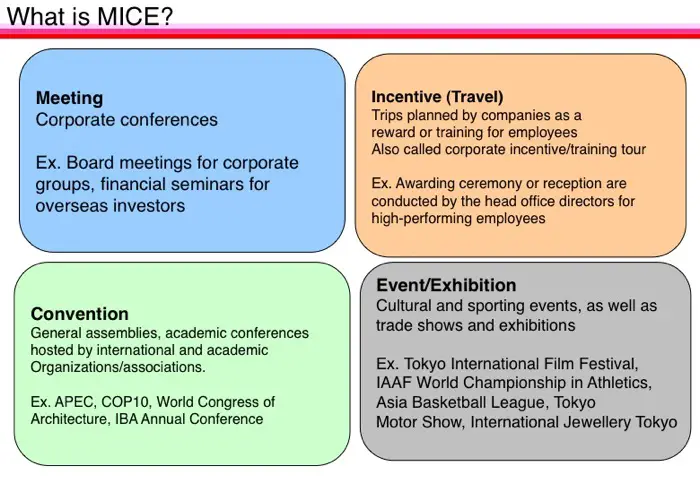
MICE
Often in the business tourism literature you will come across the term MICE. MICE stands for Meetings, Incentives, Conferences and Events (or Exhibitions). UN Tourism refers to this sector as ‘the meetings industry’. The World Tourism Organisation.
The MICE industry contributes significantly to the wider business tourism sector. It is becoming increasingly recognised as a prominent part of the industry and is beginning to receive growing attention amongst the academic community. There is a detailed article on MICE tourism here.
Leisure time activities
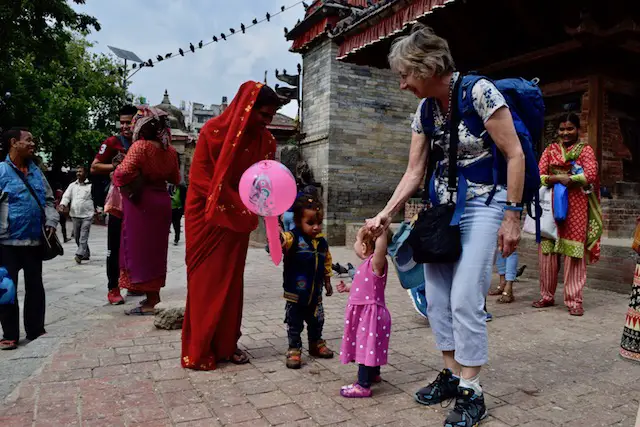
Along with the activities above, business travellers often take part in leisure activities outside their business commitments, such as dining out, sightseeing and attending cultural events. Many conferences also include gala dinners and social programmes that showcase local culture.
Benefits of business tourism
There are many benefits of business tourism. Notably, it brings economic value to the wider tourism industry as well as the local economy, for example through hotel bookings or sales of business travel backpacks. Business tourism can also have benefits for the travellers themselves.
Travelling frequently for work can bring many benefits for the individual, such as:
- Collecting frequent flier miles and redeeming these for personal use
- Becoming a member of hotel loyalty programmes and receiving associated benefits during both work and personal trips
- Saving money on things such as food and drink when attending corporate hospitality events
- Enhanced networking opportunities that may otherwise be inaccessible
- Taking advantage of leisure opportunities that may be otherwise inaccessible
- Enjoying the use of facilities, such as gyms or swimming pools, that may not otherwise be available
Business tourism destinations

There are a variety of business tourism destinations all across the world. However, this type of tourism is predominantly situated in global north countries. This is mainly because global north countries are developed countries and have the means to provide well equipped resources and infrastructure to make business tourism easily accessible and thus desirable choices among business travellers.
An analysis of flight and hotel bookings between 2014 and 2018 by corporate travel company Egencia identified the following top 20 destinations for global business travel.
Top business tourism destinations
| 1. New York | 11. Dubai |
| 2. London | 12. Mexico City |
| 3. Paris | 13. Boston |
| 4. Shanghai | 14. Montreal |
| 5. Toronto | 15. Beijing |
| 6. Singapore | 16. Los Angeles |
| 7. San Francisco | 17. Mumbai |
| 8. Hong Kong | 18. São Paulo |
| 9. Tokyo | 19. Casablanca |
| 10. Chicago | 20. Seoul |
Some of the leading business tourism destinations are outlined below.
Business tourism in Hong Kong
Hong Kong ranks 8th in the world for global business tourism and has long been one of Asia’s top choices for business travel. According to CTM, Central and Tsim Sha Tsui are the most popular commercial areas for business travel, with several hotels and business headquarters.
Hong Kong is a major destination for MICE (meetings, incentives, conferences and exhibitions), with large venues such as the Hong Kong Convention and Exhibition Centre and AsiaWorld-Expo. Its business tourism was badly affected by the protests of 2019 and the long COVID-19 restrictions, but has been recovering since the border reopened in 2023.
Hong Kong has hundreds of hotels, many of them in the business districts of Central, Admiralty and Tsim Sha Tsui.
There are a variety of things to do in Hong Kong during a business trip for travellers wanting to blend business and leisure together. Popular options include:
- Victoria Peak
- Tian Tan Buddha
- Victoria Harbour and the Peak Tram
Business tourism in London
London ranks 2nd in the world for global business tourism. London is one of the world’s leading financial centres, home to many high-profile companies, and is considered one of the best places to network and seek new business opportunities. This is why so many business tourists visit London for conferences, meetings and exhibitions.
London has well over 1,500 hotels, ranging from budget chains to luxury five-star properties, and major venues such as ExCeL London and the Business Design Centre.
There are a variety of things to do in London during a business trip for travellers wanting to blend business and leisure together. Popular options include:
- Big Ben
- Buckingham Palace
- The London Eye
- The British Museum
- Palace of Westminster
Business tourism in New York
In 2019, New York was named the world’s top destination for business tourism for the fourth consecutive year. This is no surprise, given that business travel flight bookings increased by more than 120% between 2014 and 2018.
New York is also a popular destination for business tourism as it offers a great deal of leisure activities and promotes the idea of blending business with leisure travel.
There are a variety of things to do in New York during a business trip for travellers wanting to blend business and leisure together. Popular options include:
- Statue of Liberty National Monument
- Central Park
- Empire State Building
- The Metropolitan Museum of Art
Business tourism in Toronto
Toronto has been ranked the 5th destination for global business tourism, outranking major commercial centres in the U.S.
Toronto is the financial capital of Canada and a major destination for conventions and association meetings, including many US-based associations holding meetings outside the USA.
The city has a large and growing hotel stock, and major venues such as the Metro Toronto Convention Centre.
There are a variety of things to do in Toronto during a business trip for travellers wanting to blend business and leisure together. Popular options include:
- CN Tower
- Casa Loma
- Royal Ontario Museum and the Art Gallery of Ontario
Business tourism in San Francisco
San Francisco has been ranked 7th in the world for global business tourism. As the gateway to Silicon Valley, it attracts large numbers of technology-related business travellers and hosts major conferences at the Moscone Center.
Business travel to San Francisco was hit particularly hard by the COVID-19 pandemic and the rise of remote working in the technology sector, but large tech and AI conferences have helped the city’s convention business to recover.
There are a variety of things to do in San Francisco during a business trip for travellers wanting to blend business and leisure together. Popular options include:
- Fisherman’s Wharf
- Golden Gate Bridge
- Golden Gate Park
- Chinatown
Business tourism: A conclusion
Where business exists, the demand for business travel follows. Business tourism is predominantly located where there are good transport links, such as airports and railways, and a wide choice of hotels, venues and restaurants.
Business tourism is likely to continue to evolve, with trends such as bleisure travel, sustainability and the use of technology changing the way people travel for work.
For more on the different types of tourism, see this tourism glossary.
Business tourism: FAQs
Below are answers to some of the most common questions about business tourism.
What is business tourism?
Business tourism, or business travel, is travel undertaken for work-related purposes, such as attending meetings, conferences and exhibitions, taking part in incentive trips or visiting clients and colleagues in other locations.
Why is business tourism important?
Business tourism is valuable because business travellers tend to spend two to three times more per day than leisure tourists, often travel outside peak holiday seasons, and support hotels, restaurants, venues and transport. The GBTA forecast global business travel spending of US$1.57 trillion in 2025.
What is the difference between business tourism and MICE?
MICE (Meetings, Incentives, Conferences and Exhibitions) is a major part of business tourism focused on organised group events. Business tourism also includes individual business trips, such as visiting clients or working at another office.
What is bleisure travel?
Bleisure travel combines business and leisure- for example, extending a business trip over a weekend to go sightseeing. It has grown since the COVID-19 pandemic as working patterns have become more flexible.
What are the top business tourism destinations?
Leading business tourism destinations include New York, London, Paris, Shanghai, Singapore, Tokyo, Hong Kong, Toronto, San Francisco and Dubai.
Further reading
- Setting the Table: The Transforming Power of Hospitality in Business– The bestselling business book from award-winning restauranteur Danny Meyer, of Union Square Cafe, Gramercy Tavern, and Shake Shack
- Event Planning: The Ultimate Guide To Successful Meetings, Corporate Events, Fundraising Galas, Conferences, Conventions, Incentives and Other Special Events– An academic text focussing on MICE in the events industry
- MICE tourism explained
- What is a workation?
- The Business of Tourism– A introductory text to the tourism industry
